Tableau des tailles / Size Chart
Technique pour repérer la bonne taille / Technique for finding the right size
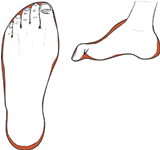
1- Mauvaise pointure :
Même avec un chausson plus large, la tension
du blocage talon forcera tout de même le pied en
compression sur la pointe. Le chausson n’ayant alors
pas de retenue équilibrée, c’est donc le gros orteil
qui reçevra le plus de charge.
Le fait de prendre une ou deux pointures au-dessus
ne change pas grand chose, si vous ne voulez pas avoir
les orteils comprimés, optez pour un modèle avec
une tension du talon modérée ou avec un laçage
pour maintenir latéralement le pied.
/
1 – Wrong size:
Even with a wider climbing shoe, the heel-tension strap will still force the foot into compression at the toe. As the shoe then lacks balanced support, the big toe will bear most of the load.
Going one or two sizes up doesn’t change much; if you don’t want your toes to be compressed, choose a model with moderate heel tension or with lacing to hold the foot laterally.
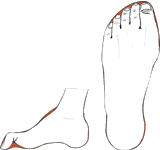
2 - Bonne pointure pour un chausson précis :
Le chausson ne doit présenter aucun vide important,
ni sur la largeur du pied ni sur le talon.
Le chausson ajusté facilitera le soutien et évitera
de se vriller avec une perte de précision.
Les points de compression seront ainsi répartis
sur l’ensemble du pied.
Un vide au-dessous de la voûte plantaire et du talon
peut se former selon la morphologie du pied,
cela ne causera aucune perte de précision.
/
2 – Correct size for a precise climbing shoe:
The shoe should not show any significant gaps, either across the width of the foot or at the heel.
A well-fitting shoe will provide better support and prevent twisting with a loss of precision.
The pressure points will thus be distributed over the whole foot.
A small gap under the arch of the foot or at the heel may occur depending on the foot’s morphology; this will not cause any loss of precision.